DESKRIPSI
Training Liquid Penetrant Testing sangat penting karena pengujian non-destruktif (NDT) adalah
metode kritis dalam memastikan keamanan dan integritas struktur dan komponen dalam berbagai
industri seperti manufaktur, konstruksi, dan perawatan pesawat terbang. Dalam pelatihan ini,
peserta akan belajar bagaimana melakukan pengujian penetrasi cair dan pengujian partikel
magnetik untuk mendeteksi retakan, cacat, atau ketidaksempurnaan lainnya dalam material,
sehingga mencegah kegagalan yang dapat berakibat fatal dan meminimalkan risiko dalam
berbagai sektor industri.
TUJUAN TRAINING
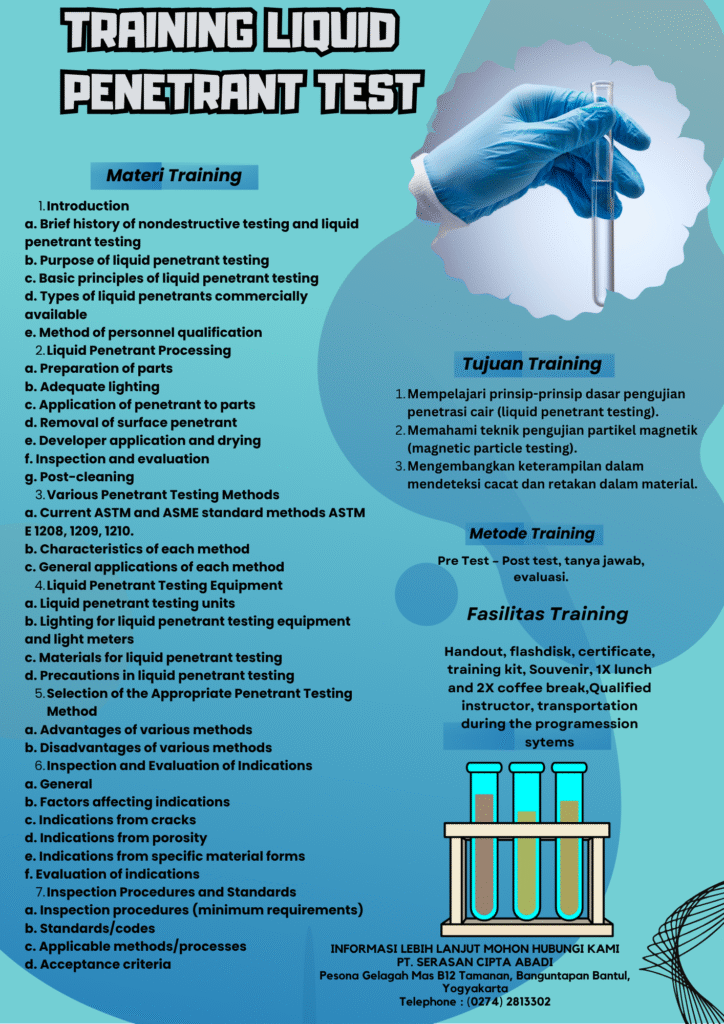
- Mempelajari prinsip-prinsip dasar pengujian penetrasi cair (liquid penetrant testing).
- Memahami teknik pengujian partikel magnetik (magnetic particle testing).
- Mengembangkan keterampilan dalam mendeteksi cacat dan retakan dalam material.
MATERI TRAINING
- Introduction
a. Brief history of nondestructive testing and liquid penetrant testing
b. Purpose of liquid penetrant testing
c. Basic principles of liquid penetrant testing
d. Types of liquid penetrants commercially available
e. Method of personnel qualification - Liquid Penetrant Processing
a. Preparation of parts
b. Adequate lighting
c. Application of penetrant to parts
d. Removal of surface penetrant
e. Developer application and drying
f. Inspection and evaluation
g. Post-cleaning - Various Penetrant Testing Methods
a. Current ASTM and ASME standard methods ASTM E 1208, 1209, 1210.
b. Characteristics of each method
c. General applications of each method
- Liquid Penetrant Testing Equipment
a. Liquid penetrant testing units
b. Lighting for liquid penetrant testing equipment and light meters
c. Materials for liquid penetrant testing
d. Precautions in liquid penetrant testing - Selection of the Appropriate Penetrant Testing Method
a. Advantages of various methods
b. Disadvantages of various methods - Inspection and Evaluation of Indications
a. General
b. Factors affecting indications
c. Indications from cracks
d. Indications from porosity
e. Indications from specific material forms
f. Evaluation of indications - Inspection Procedures and Standards
a. Inspection procedures (minimum requirements)
b. Standards/codes
c. Applicable methods/processes
d. Acceptance criteria
PT. SERASAN CIPTA ABADI
Pesona Gelagah Mas B12 Tamanan, Banguntapan Bantul, Yogyakarta
Telepon : (0274) 2813302
Whatsapp : 081227264889